


DEVELOPMENT STORY
November 24, 2023
The tale of the development of the world’s first capless fountain pen, Capless, that defied common knowledge.
The tale of the development of the world’s first capless fountain pen, Capless, that defied common
knowledge.
The Capless fountain pen, which made its sensational debut in 1963, celebrated its 60th anniversary in
2023. This is the development story of Capless, which made its mark on the world and continues to be loved
today as it evolves.
Inventing a Historic New Product At the Height of Japan’s Rapid Economic Growth
The Capless fountain pen is now one of PILOT ’s long-selling flagship products. Though a fountain pen,
it has no cap, and you can write quickly with a single click* like a retractable type ballpoint pen. It's
a functional writing instrument that keeps the ink from drying out with an airtight shutter mechanism that
seals the nib hen retracted. Building on the unchanging concept of a cap-free fountain pen, this writing
tool has evolved into a series of variations with new functionality and designs.
*In addition to retractable type pens, there are also twist and retractable
twist models.

With a click, Clicking the button opens the shutter and the pen nib comes out
The development of the Capless pen began in 1960, right in the middle of Japan’s period of rapid economic
growth. In 1958, Tokyo Tower was completed as a symbol of post-war recovery, and the country was
experiencing rapid development, including preparations for the Tokyo Olympics and the launch of the
Tokaido Shinkansen high-speed railway. Around this time, TVs and other home electronics began to reach
everyday households, and instant ramen and instant coffee became popular, leading to a push for more
convenient and efficient products.
In the stationery industry, the release of the Pilot Super fountain pen in 1955 established PILOT as a
leader in the fountain pen market. At the same time, with the liberalization of trade, the market was
gradually flooded with Western-made fountain pens, and new writing instruments, such as ballpoint pens and
mechanical pencils, began to be introduced as practical alternatives to fountain pens.
While developing ballpoint pens and other writing instruments besides fountain pens, PILOT was
simultaneously developing various concepts for a futuristic fountain pen that would surpass the Pilot
Super. One of these ideas was for a fountain pen without a cap. Ever since the fountain pen’s introduction
in the early 1800s, the idea that fountain pens have caps had remained an unquestioned idea for 150 years.
The concept of a capless fountain pen was something entirely new and pioneering.
Fountain pens cannot be left uncapped, as the ink will dry out and the pen will no longer write. For this
reason, an airtight cap has been essential to protect the pen nib and prevent the ink from drying. As a
result, removing the cap was always required before writing, causing a time lag between the moment
inspiration struck and putting pen to paper. In addition, when placing a fountain pen into a breast
pocket, there was the risk of accidentally staining one's shirt with ink. These were long-standing issues
associated with fountain pens.
To turn this dreamlike idea of overcoming these challenges into reality, in 1960 PILOT launched a
development project for a capless fountain pen, which would later go on to greatly alter the history of
fountain pens.
Developing Even A Hydrogen Furnace for Special Stainless Steel
Processing!
All to Make a Dream Come True
To make the fountain pen smoother and more convenient, engineers explored ways to eliminate the cap,
which had long been considered indispensable, exchanging and refining their ideas.
What kind of mechanism is needed to prevent ink from leaking or drying out without a cap? What about a
structure that allows the pen nib to be retracted into the pen body? In that case, an internal mechanism
to replace the cap would be necessary. The more the engineers thought, the more challenges piled up,
forming a massive barrier before the development team.
To realize these ideas simultaneously, it was essential to develop a mechanism that would allow the pen
nib to extend and retract smoothly, along with a high level of airtightness to prevent ink leakage and
drying. Fitting all of these mechanisms into an extremely narrow space inside the slim pen body was by no
means an easy task.
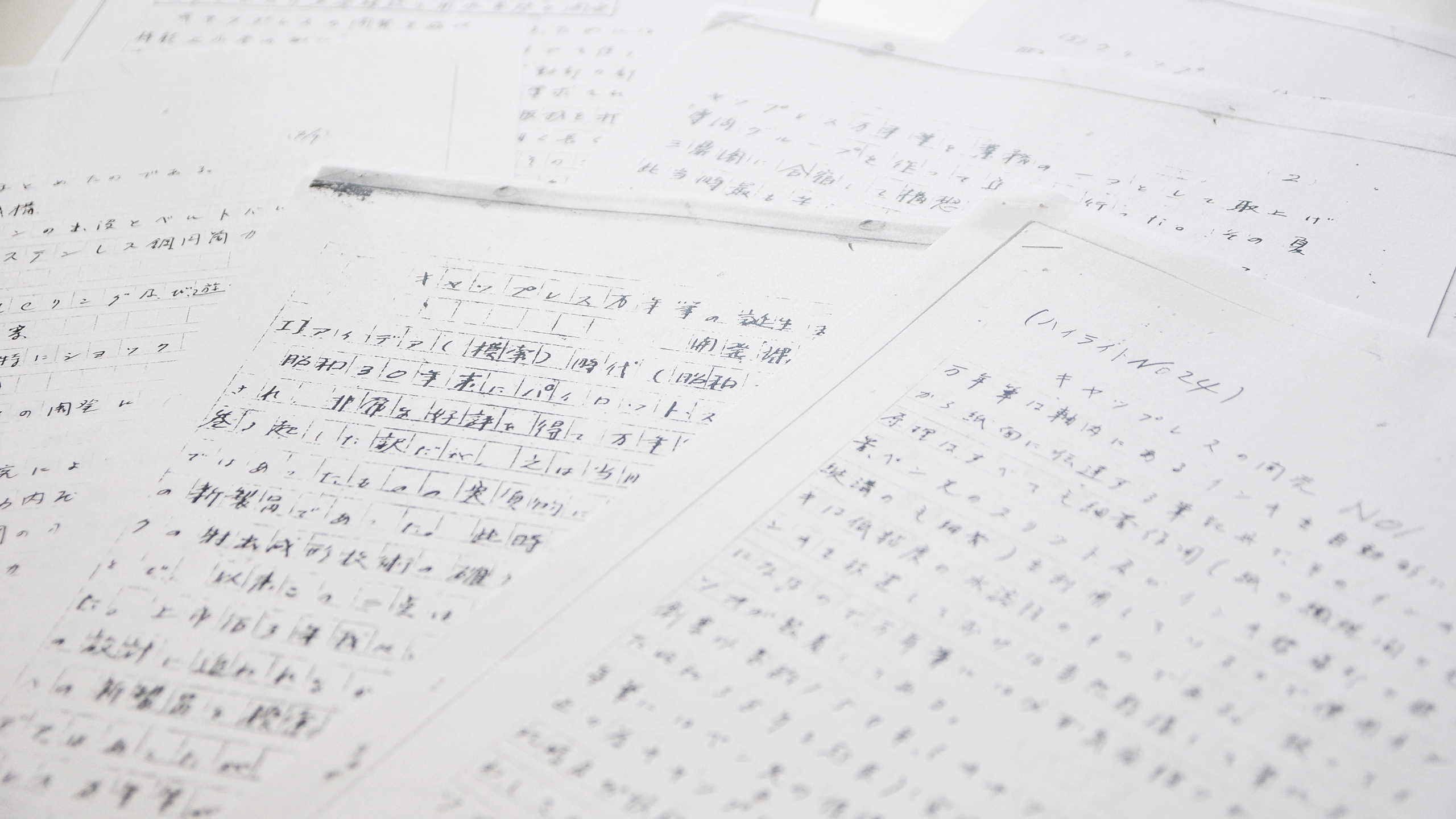
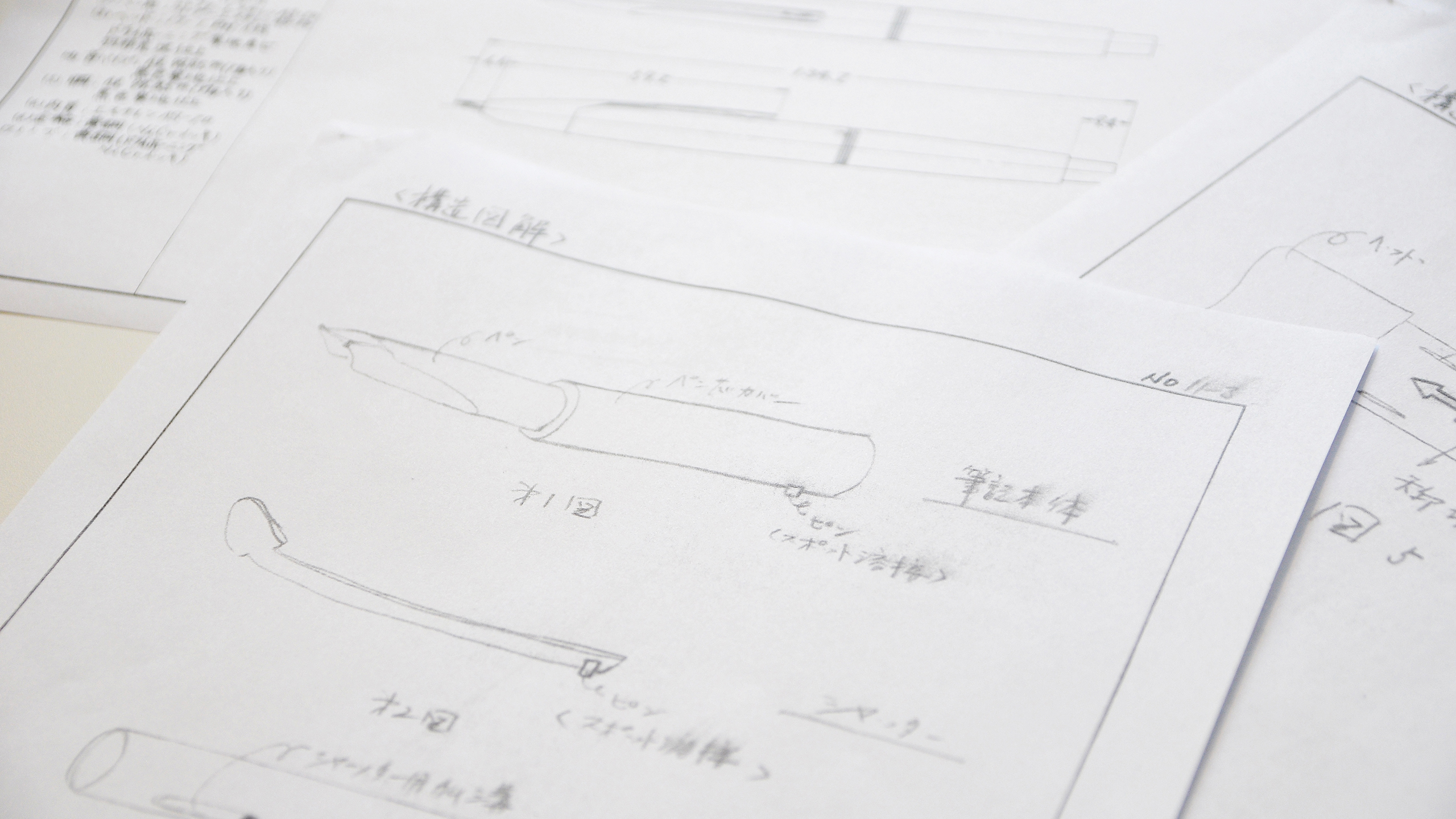
The engineers drafted each idea into detailed drawings and built numerous prototypes by hand. They looked
at various mechanisms for extending and retracting the pen nib, including retractable type, slide-type,
and twist-type systems, as well as different methods for both opening and closing the lid to maintain
airtightness in place of a cap and for supplying ink. However, even after combining these ideas into
prototypes, satisfactory results remained elusive.
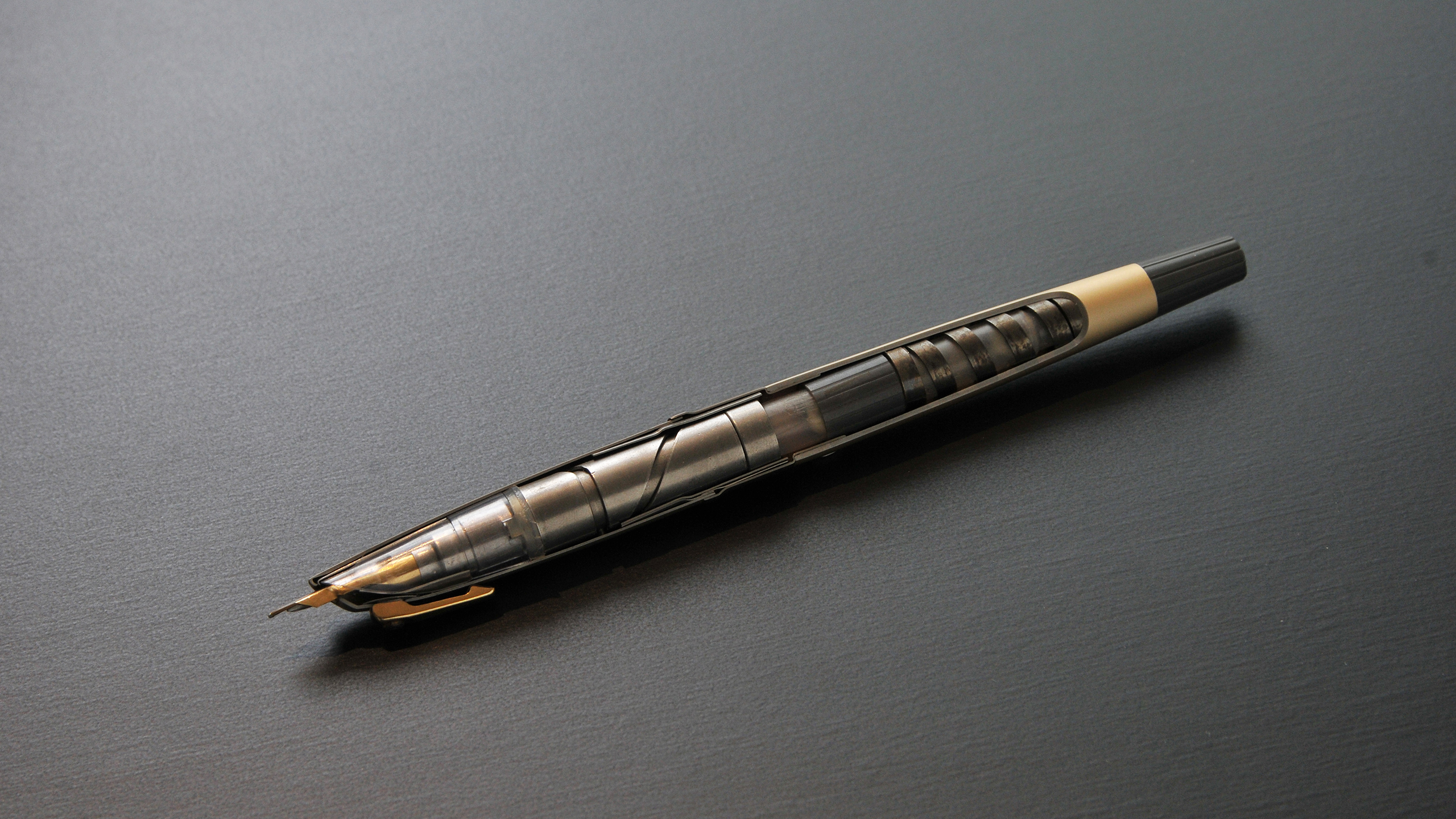
In early 1961, after refining the design through numerous prototypes, they narrowed down the plan and
finally completed a full-scale prototype using molds and machinery. The design featured a mechanism in
which rotating the barrel extended the pen nib through an internal screw mechanism, while a belt-slide
system opened and closed the shutter. When this prototype was unveiled internally, it was met with
enthusiastic applause for the unprecedented capless fountain pen.
While the first design model established the basic mechanism, significant challenges still remained.
Brass was used for the internal components in the prototype, but it was inadequate as a material due to
corrosion from ink components and durability issues under repeated extension and retraction of the pen
nib.
Plastic and aluminum were considered as alternatives to brass, but in the end, strong stainless steel
proved most suitable. However, the movable parts that repeatedly extended and retracted the pen nib were
small in diameter and required highly precise machining to ensure smooth, complex motion. On top of that,
forming flat stainless steel plates into highly precise pipe shapes required the adoption of a complex
process known as stainless steel deep-drawing press forming.
Implementing the specialized heat treatment essential for this metal processing required a hydrogen
furnace, something that had yet to become commonplace at the time. So the developers sourced the necessary
components themselves and hand-built a small hydrogen furnace for trial production. After a series of
failures, they finally completed a prototype incorporating the new stainless steel mechanism several
months later. The stainless steel processing technology achieved through the developers’ determination and
extraordinary efforts became a crucial breakthrough in realizing the previously impossible capless
fountain pen.
In 1962, development moved from the lab to the factory, with developers finally working to build a
production line. A team was formed in anticipation of mass production, and preparations were focused on
precision, durability, and other aspects to ensure quality and efficiency in production.
High-precision stainless steel processing was achieved on a small scale in the lab, but transitioning to
mass production required detailed revisions and adjustments, with developers and factory engineers
conducting further investigations each time issues arose. It was in 1963, the third summer since
full-scale development began, that these difficulties were finally overcome and preparations for mass
production were completed.
Japanese-made Capless Wins Global Acclaim
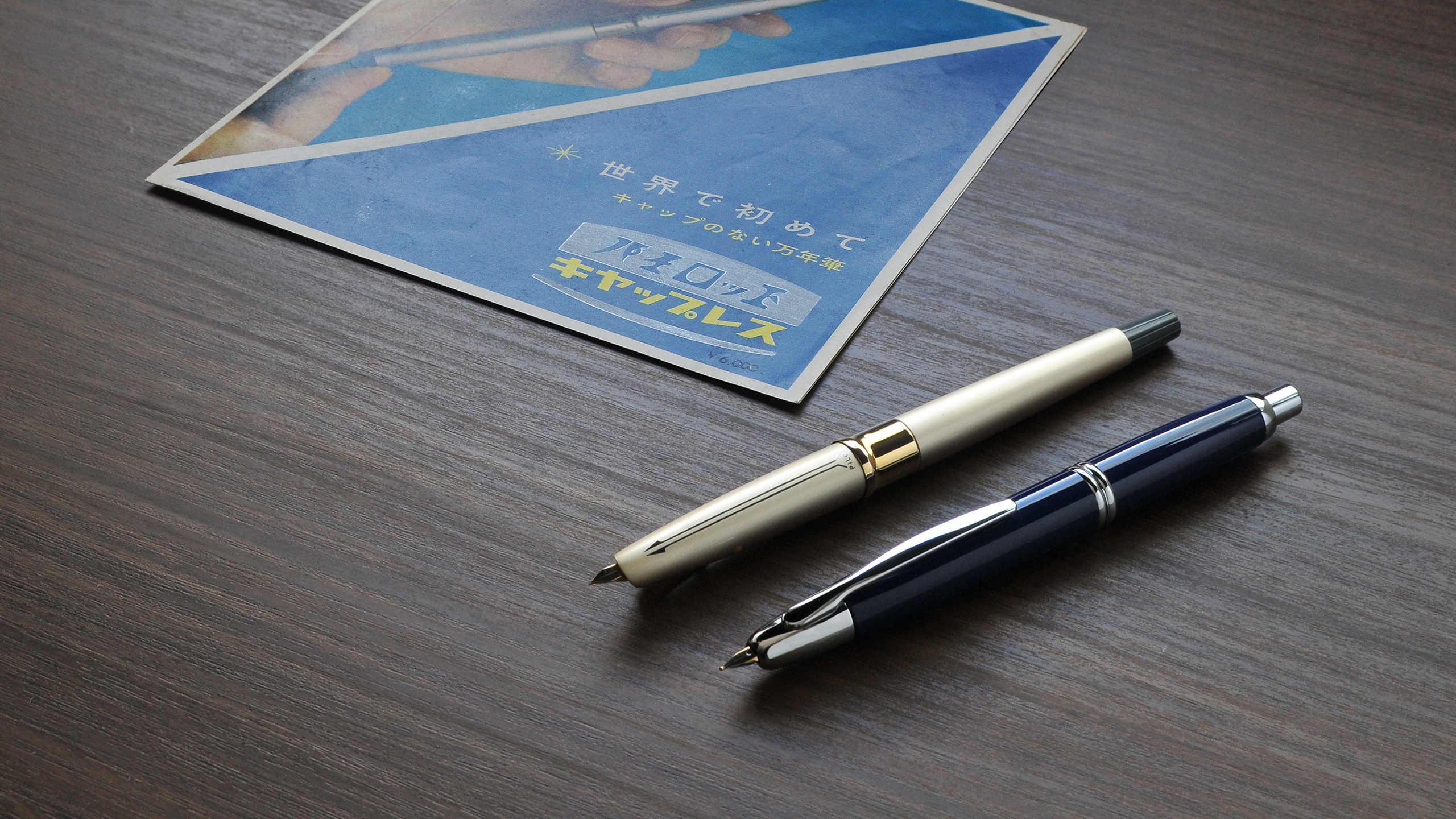
In November 1963, the cap-free Capless fountain pen was released as a groundbreaking new product with features such as the ability to write quickly with a single action, an airtight design that prevents ink drips, and a durable internal stainless steel construction. In Japan alone, it was reported on by more than 50 newspapers, drawing nationwide attention. A TV commercial showing the pen nib emerging as the shutter opened when the pen body was twisted captivated viewers with its futuristic feel and sent customers rushing to stationery stores. The Capless quickly became a hit following its dazzling debut.
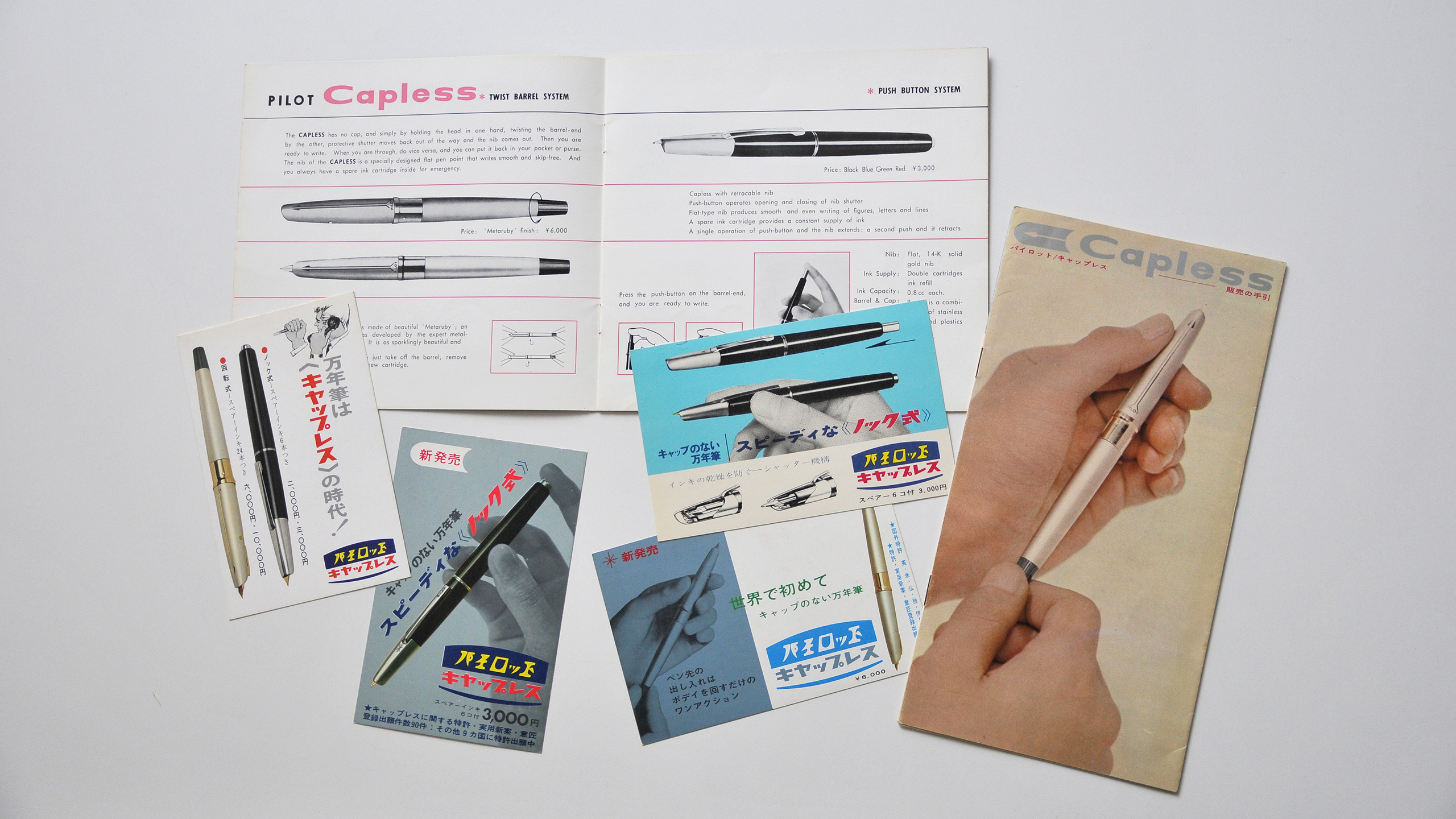
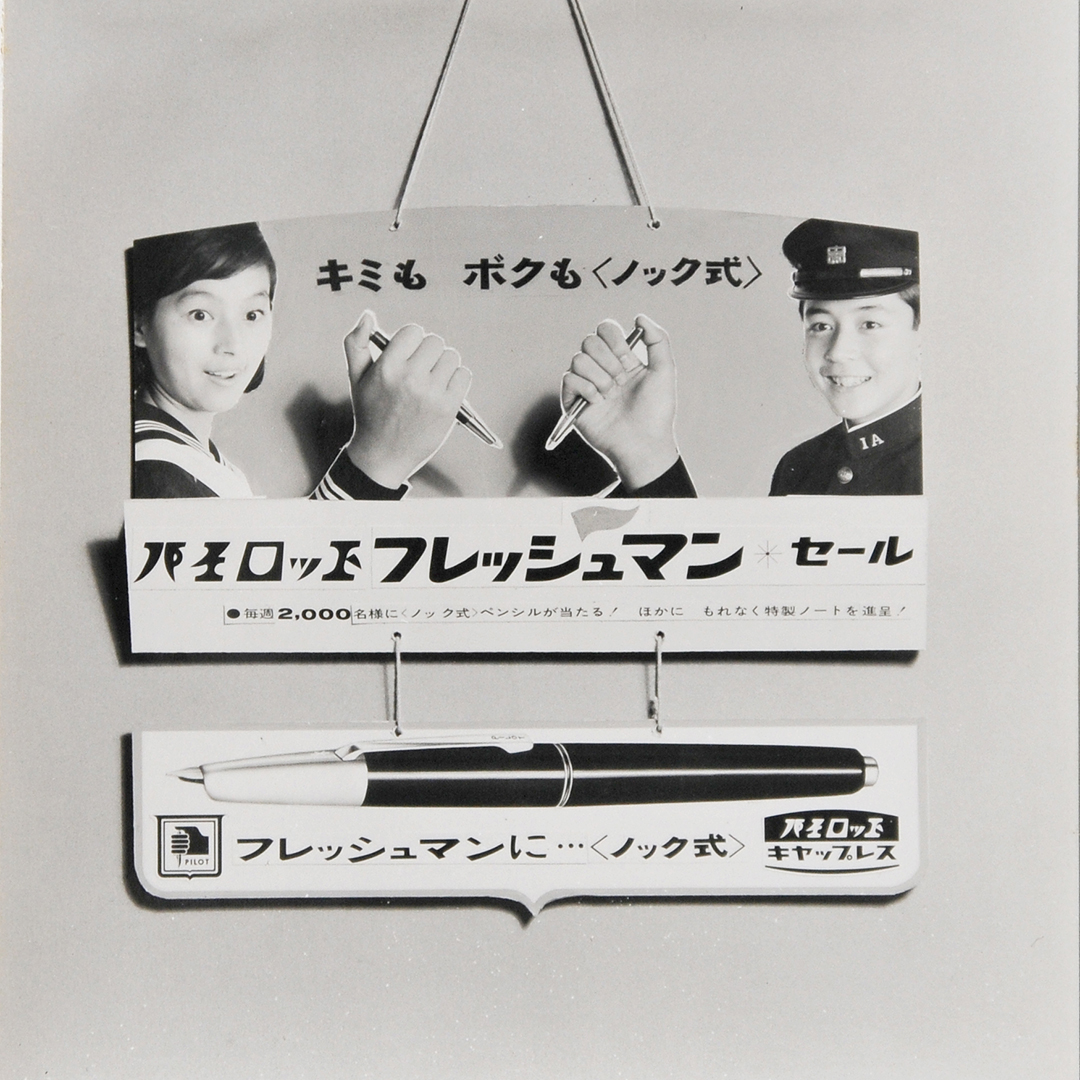
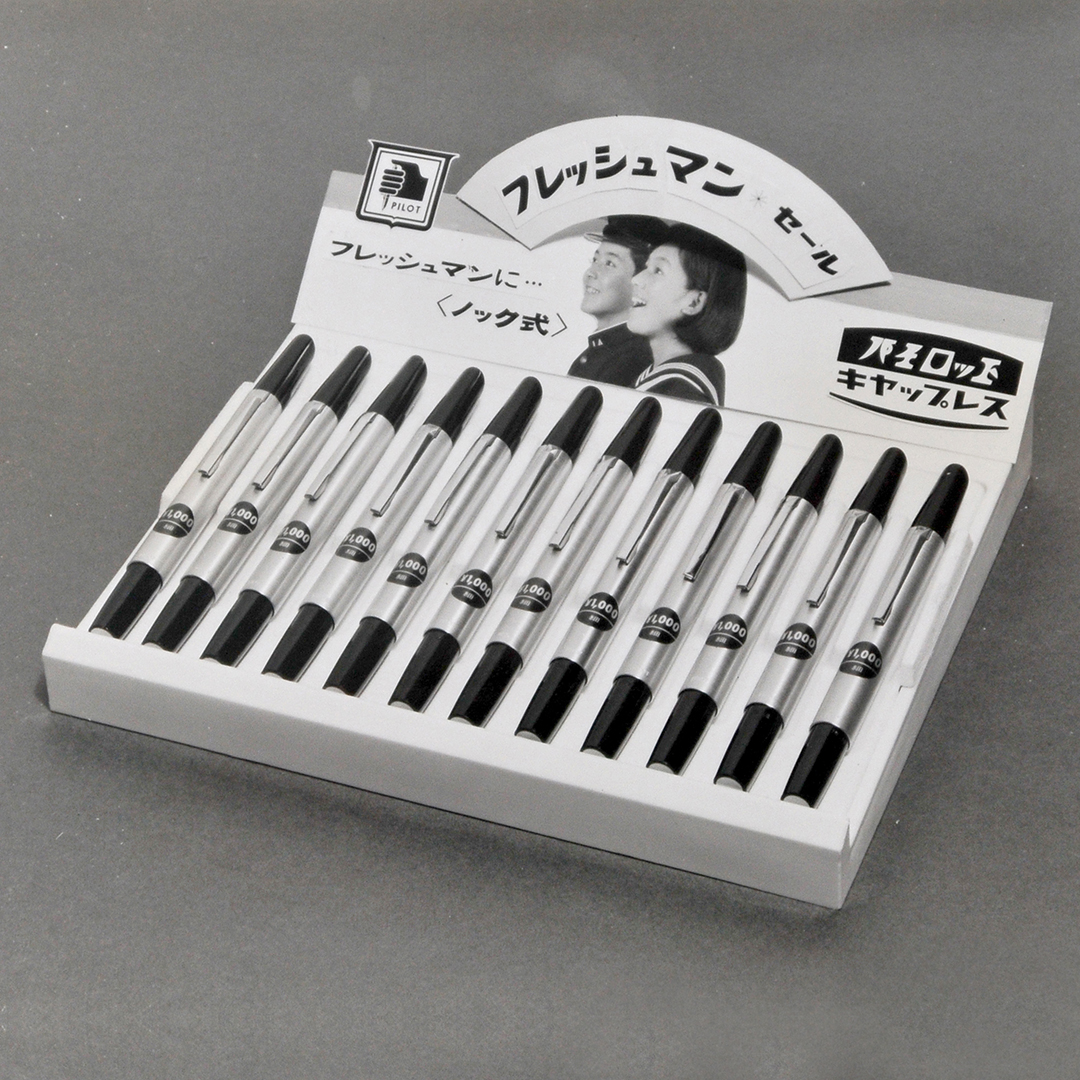
Pamphlets and postcards from the time of Capless’ release, as well as sales manuals, displays, fixtures, and other promotional tools. There were 90 patent, utility model, and design registration applications related to the Capless, with patent applications filed in 9 countries outside Japan, as well.
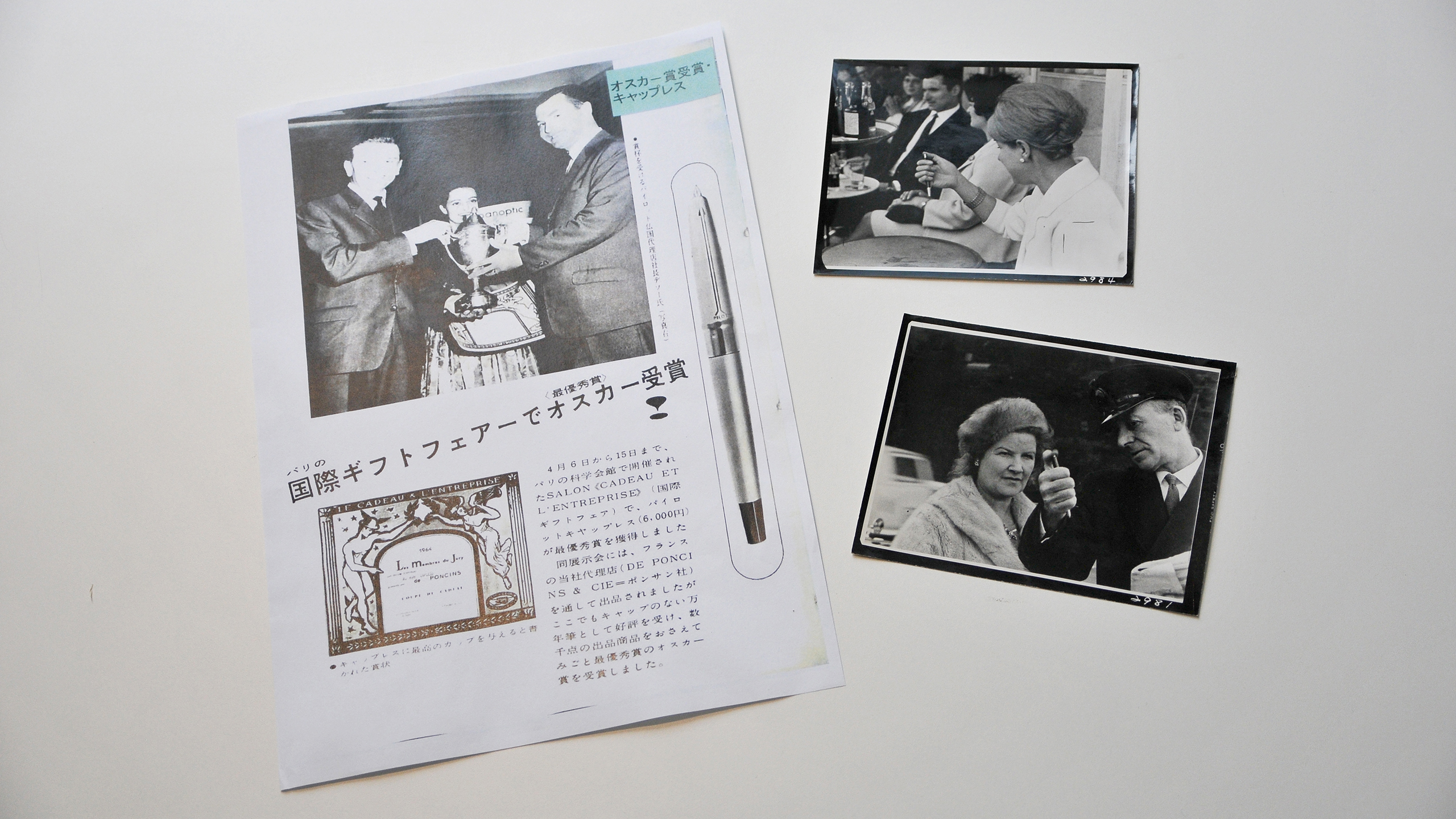
The Capless took the market by storm after overcoming many challenges, six years after engineers first conceived the idea. In 1964, a year after its release, a retractable version was introduced following the twist type, with the Capless receiving the Good Design Award in Japan. When it was exhibited at the International Gift Fair in Paris, it won the top prize, the Most Recommended Product Award, surpassing thousands of other entries. It earned acclaim as the world's most innovative and captivating product. In 1965, its production technology was also recognized with the Okochi Memorial Technology Prize, one of Japan’s most prestigious awards in production engineering.
The Capless sparked a movement so strong that it came to be synonymous with fountain pens. The following words were recorded in an informational magazine of the time.
“Yet even the Capless cannot be said to represent the final form of the writing instrument. In the years to come, new implements, still more convenient and more rational, will surely be invented. So long as mankind does not cease to think, the act of writing shall not decline, and with it, people will continue to call for writing instruments of ever greater convenience. And while such demands endure, the writing instrument, too, will steadily advance along the path of progress.
These words look beyond the Capless to the future of writing instruments. Since then, PILOT has continued to create groundbreaking writing instruments, and the Capless itself has continued to evolve from its early development to the present day and is still loved by many.
<
1
2
3
>